
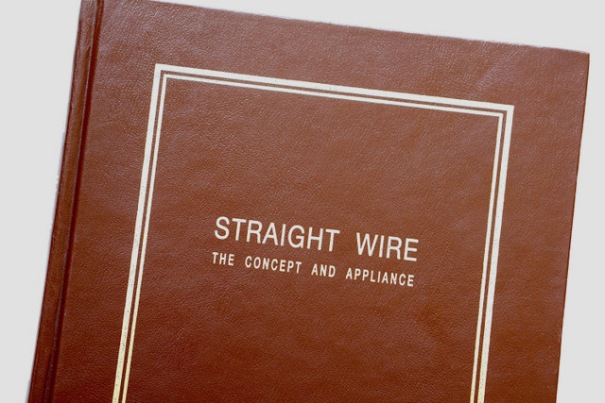
In 1989, a Californian orthodontist, Lawrence F. Andrews, published a book where he accurately described his landmark invention of the straight-wire appliance. I am honoured to have a signed copy of this historic text, which he gifted me four years ago while I was travelling across America. Being an undisciplined reader, I Iet it sit on the shelf till last Christmas.
The book Straight Wire: The Concept and Appliance tells the story of how a study of 120 casts of naturally optimal occlusion led to the development of the first preajdusted appliance. It is a carefully written text explaining basic concepts behind the straight-wire appliance. It has plenty of beautiful drawings, but from the viewpoint of a clinician the most exciting part of the book is 200+ photos of before and after dental casts. These are the records from 1960s and 1970s collected by a number of orthodontists. The quality of the results is exceptional.
I decided not to indulge myself into retelling the six keys and straight-wire philosophy, but rather write my own subjective ideas loosely based on the book…

Here they are:
1. What you have learned is not really important until you apply it.
If the straight-wire appliance hasn’t been developed, the six keys would have been just a collection of abstract observations.
2. Be thankful for what you have.
The invention of the straight-wire appliance in 1970 has greatly reduced the number of archwire bends and made the lives of many orthodontists around the globe much easier. However, the simplification of several procedures has let some people to believe that the entire orthodontic treatment is very easy to perform. This, in turn, has increased the number of poorly trained practitioners.
Nevertheless, I think that the advantages of the straight-wire appliance outweigh the negative consequences. And we have to be thankful for the fundamental virtues embodied into the appliance which we use on a regular basis.
3. There is no one-size-fits-all solution.
Despite the versatility of the appliance, it always requires some adjustments for each and every patient as well as meticulous fine-tuning at the finishing stages of the treatment. There is no such thing as 100% preadjusted appliance.
4. Sometimes it’s fine not to follow the rules.
No doubt, we have to keep in mind the six keys, but we also have to understand that in some cases it is prudent not to aim for meeting all of the them.
5. Truth speaks softly.
Travelling across America four years ago, I met a number of famous orthodontists, most of them were great speakers. Andrews was one of the last on my list and I had never heard him speaking before. I was excited to meet the man who has turned the orthodontic world upside down. I expected to meet a charismatic leader with a powerful voice and radiant energy. I was surprised to meet a man who spoke slowly and quietly, almost stammering at times. His manners contrasted with those of popular opinion leaders who usually go to great lengths glamourising new appliances of the companies they are affiliated with.
6. If you have some observations, organise them into points – let’s say six – and this will be well perceived by the public.
 Orthodontic Grammar
[…] I wrote a blog post and then shot a video ranting about Dr. Lawrence Andrews and the virtues of having a prescription. […]
LikeLike
[…] the long axis of a crown. For more fundamentals on the straght wire appliance I highly recommend this classic book by Lawrence Andrews. No financial interests to […]
LikeLike
[…] seems that Andrew’s invention of the preajusted appliance in 1970s turned to be a blessing in disguise. This event, combined with the new advertising policy of the […]
LikeLike